Technology
Superconducting Computing
Superconducting digital logic using Josephson junctions and single flux quantum (SFQ) technology for extreme energy efficiency.
8 companies
Explainer
Superconducting Computing explained
Superconducting computing uses circuits made of materials that have no electrical resistance when cooled below a critical temperature. The common material is niobium, which works at about 4 kelvin (around minus 269 degrees Celsius), the temperature of liquid helium. Without resistance, the wires do not waste energy as heat.
The main logic families are built from Josephson junctions, tiny switches that flip in picoseconds and send out single flux quanta, the smallest units of magnetic flux. Rapid single flux quantum (RSFQ) logic and its lower-power variants can run at tens of gigahertz in lab circuits. This page covers classical superconducting logic. Superconducting qubits are a separate use of the same physics and belong under quantum computing.
How it differs from the usual approach
CMOS chips lose most of their energy as heat in resistive wires and switching. Superconducting circuits switch with very little energy and move signals with almost no loss. The catch is cooling. The cryogenic system needs power of its own, and it is only worthwhile if the whole system, cooler included, comes out ahead. Density is also lower than CMOS, and there is no practical large-scale superconducting memory.
Where it is used
- Research prototypes of low-power, high-speed processors.
- Control and readout electronics for superconducting quantum computers.
- Sensors and detectors, such as SQUID magnetometers and superconducting single-photon detectors.
- Fast analog-to-digital converters for specialised radio and scientific work.
- Studies of energy-efficient AI hardware.
What to watch
- US government programs, including IARPA's Cryogenic Computing Complexity program, funded research into superconducting computers in the 2010s.
- Interest has returned partly because large quantum computers already need cryogenic infrastructure.
- Memory and chip density are the largest unsolved problems for classical superconducting computers.
- Whether total energy, including cooling, beats advanced CMOS at scale is still an open question.
Frequently asked questions
What is superconducting computing?
It is computing with circuits that have no electrical resistance at very low temperatures. Switches called Josephson junctions replace transistors, and they use very little energy per operation.
Is it the same as quantum computing?
No. Classical superconducting logic still works with ordinary 0s and 1s. Superconducting qubits use related physics to build quantum computers, which is a different kind of machine.
Why are superconducting computers not common?
They need cryogenic cooling, the circuits are less dense than CMOS, and good memory for them is missing. The cooling energy also has to be counted against the savings.
- Single Quantum Delft spin-off of TU Delft making superconducting nanowire single-photon detectors, including the Eos multi-channel system and Eos R12 rack unit, used in photonic quantum computing and quantum key distribution. Its 2025 brochure says more than 300 labs use the Eos system. Quantum Computing · Superconducting Computing —

- Quantcore University of Glasgow spin-out, founded in August 2025, that makes niobium-based superconducting processors, resonators and sensors at the James Watt Nanofabrication Centre. It raised a 2.5 million pound seed round announced on 24 February 2026, co-led by PXN Ventures, Blackfinch Ventures and Scottish Enterprise. Quantum Computing · Superconducting Computing GBP 2.5M seed, Feb 2026

- Qilimanjaro Quantum Tech Barcelona company building superconducting quantum systems, including an analog quantum computer at the Barcelona Supercomputing Center co-funded by EuroHPC. It announced a first close of nearly 19.6 million euros of a Series A led by Indra Group on 14 October 2026. Quantum Computing · Superconducting Computing EUR 19.6M Series A first close, Oct 2026

- imec Imec is a large independent research and innovation centre for nanoelectronics and digital technology, not a startup. It is headquartered in Leuven, Belgium, works with industrial partners, startups and more than 200 universities, and runs a 300 mm semiconductor pilot line. This entry covers its research into superconducting electronics and quantum devices, which aims to use standard chip manufacturing methods to build circuits that carry current with no resistance at very low temperatures. Its website describes a staff of about 6,500. Superconducting Computing · Quantum Computing —

- QuamCore Israeli developer of a superconducting quantum architecture that places digital control logic inside the cryostat, designed for one million qubits. It raised a $26 million Series A led by Sentinel Global in August 2025, bringing total funding to $35 million; the architecture is simulated and not yet built in hardware. Quantum Computing · Superconducting Computing $26M Series A, Aug 2025

- SEEQC SEEQC builds a digital-chip platform for quantum computing that pairs superconducting qubit chips with classical control chips based on single flux quantum logic, packaged together inside the cryostat. Conventional machines keep control electronics at room temperature and connect them with many cables. SEEQC's control logic sits in the cold stages close to the qubits, which the company says supports fast on-chip readout and feedback. It also offers chip foundry and fabrication services, and its site gives 2019 as its founding year. Quantum Computing · Superconducting Computing $30M Series A extension (Jan 2025)

- HYPRES HYPRES develops superconductor electronics, circuits that operate at extremely low temperatures where electrical resistance vanishes. Its digital chips use single flux quantum, or SFQ, logic, which encodes bits as tiny pulses of magnetic flux and can switch very fast using little energy. The company is based in Elmsford, New York, and was founded in 1983. The quantum computing firm SEEQC describes itself as a spin-out of HYPRES. Superconducting Computing —

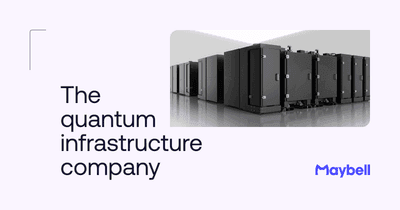
- Maybell Quantum Colorado maker of dilution refrigerators and cryogenic RF systems for quantum computers, including the Big Fridge developed with Colorado School of Mines. It raised a $25 million Series A in March 2024 and a $40 million Series B led by Addition in September 2025, and is to deploy four refrigerators at the Roadrunner Quantum Lab in Albuquerque by September 2026. Quantum Computing · Superconducting Computing $40M Series B, Sep 2025