Technology
Quantum Computing
Quantum computing hardware using superconducting, trapped-ion, photonic, or neutral-atom qubits for solving problems intractable for classical computers.
104 companies
Explainer
Quantum Computing explained
A quantum computer is a machine that uses the rules of quantum physics to process information. Its basic unit is the qubit. A classical bit is either 0 or 1. A qubit can be in a superposition, a state that combines both, and its measured result is probabilistic.
Qubits can also be entangled, which means their outcomes are correlated in ways classical bits cannot be. Quantum algorithms arrange these effects so that wrong answers cancel and right answers become more likely. Qubits are fragile, and noise from the environment (decoherence) causes errors, so practical machines need error correction.
How it differs from the usual approach
A quantum computer is not a faster classical computer. It is only expected to beat classical machines on certain problems, such as simulating quantum systems and factoring large numbers with Shor's algorithm, where the best known classical methods scale much worse. For everyday tasks such as browsing, databases or most AI work there is no expected advantage. The number of qubits alone says little about usefulness. Error rates, connectivity and the ability to correct errors matter just as much.
Where it is used
- Research into simulating molecules and materials.
- Testing algorithms for optimisation and for factoring and search problems.
- Cloud access for researchers and companies to experiment with early hardware.
- Work on quantum error correction and on logical qubits.
- Planning for post-quantum cryptography, since a large machine could break widely used public-key encryption.
What to watch
- Several hardware approaches compete: superconducting circuits, trapped ions, neutral atoms, photons and spins in silicon. None has clearly won.
- The field is shifting from counting physical qubits to demonstrating error-corrected logical qubits with falling error rates.
- In 2019 Google claimed a quantum advantage on a sampling task with 53 qubits. That task had no practical use, and the claim was debated by classical-computing researchers.
- NIST published its first post-quantum cryptography standards in August 2024, so organisations can start moving off encryption that a future large machine could break.
Frequently asked questions
Are quantum computers faster than normal computers?
Only for specific problems. They are expected to help with simulating quantum systems and some mathematical tasks such as factoring. For most everyday computing they offer no advantage.
Does more qubits mean a better quantum computer?
Not by itself. Qubit quality, error rates, how qubits connect and the ability to correct errors decide what a machine can do. A smaller machine with low errors can beat a larger noisy one.
When will quantum computers break encryption?
Nobody can say for sure. It would take a large, error-corrected machine, which does not exist today. Standards bodies have already published post-quantum encryption standards so that systems can move early.
- Single Quantum Delft spin-off of TU Delft making superconducting nanowire single-photon detectors, including the Eos multi-channel system and Eos R12 rack unit, used in photonic quantum computing and quantum key distribution. Its 2025 brochure says more than 300 labs use the Eos system. Quantum Computing · Superconducting Computing —

- OptQC OptQC develops photonic quantum computers, which use particles of light as the carriers of quantum information rather than superconducting circuits or trapped atoms. The company says this approach offers good scalability and energy efficiency and fits well with optical communications. It is headquartered in Tokyo, in the Toshima ward. Its website names Kan Takase as chief executive and Noriaki Iwata as chief operating officer, and describes an industry hub called HIQALI for optimisation, AI and machine learning uses. Quantum Computing · Photonic Computing 1.5B yen Series A1 (Oct 2025)

- Qubitcore Qubitcore builds quantum computers based on trapped ions, which are charged atoms held in place by electromagnetic fields and used as qubits, the basic units of quantum information. Its design combines the ion traps with micro-optical cavities, small mirror structures intended to let ions exchange information through photons. The company says this approach offers high-fidelity gates, flexible connectivity and long coherence times, meaning accurate operations and qubits that keep their state for longer. Its website states that it works in collaboration with the Okinawa Institute of Science and Technology. Quantum Computing JPY 1.53B (~$9.6M) seed (April 2026)

- QuiX Quantum QuiX Quantum builds photonic quantum computers, which use particles of light as qubits and route them through chips instead of through large optical tables. Its products include Carina, which the company describes as a universal system, and Alqour 2.0, a programmable photonic processor for research. A photonic processor steers light through a network of tiny waveguides etched in a chip, so interference between photons does the calculation. The company lists offices in Enschede and Amsterdam in the Netherlands and in Stuttgart and Ulm in Germany. Quantum Computing · Photonic Computing €15M Series A (Jul 2025, co-led by Invest-NL and EIC Fund; total ~€24M)

- Nord Quantique Nord Quantique is working toward error-corrected quantum computers using superconducting bosonic codes. Instead of spreading one logical qubit across many physical qubits, it stores a logical qubit in the states of a single microwave resonator, with the aim of keeping systems small enough to fit in an existing data centre. The company reports a first industry demonstration of quantum error correction in 2023, which is a small step and not a fault tolerant machine. It is headquartered in Sherbrooke, Quebec, where it began hardware operations in 2020, and is part of the Canada Quantum Champions Program. Quantum Computing $30M (May 2026, $1.4B val, Fidelity-backed); $16M CQCP (Dec 2025)
- Bluefors Bluefors makes dilution refrigerators, the cryogenic machines that cool superconducting quantum computers and physics experiments to a few thousandths of a degree above absolute zero. It also makes cryocoolers and cryogenic measurement systems. Bluefors was founded on 17 March 2008 by Rob Blaauwgeers and Pieter Vorselman, is headquartered in Helsinki, Finland, and has grown through acquisitions that include Cryomech in the United States and Rockgate in Japan. Quantum Computing —

- Quantum Machines Tel Aviv company that sells control and readout electronics and software for quantum processors, including the OPX1000 platform. It announced a $170 million Series C led by PSG Equity in February 2025 and says its customers include more than half of the companies building quantum computers. Quantum Computing $170M Series C, Feb 2025

- Aliro Quantum Aliro sells software for building and running entanglement networks, which link quantum devices by sharing entangled particles rather than only sending ordinary data. Its products include a simulator for designing and testing networks, AlirOS for controlling network hardware, and an orchestrator for day-to-day network operations. It does not make quantum hardware itself, so it sits in the software layer of quantum networking. Its website lists Stony Brook University, Cisco, Boeing, EPB, Noblis and Brookhaven National Laboratory among its customers. The legal entity is Aliro Technologies, Inc. Quantum Computing $15M oversubscribed round (Feb 2026)

- Atlantic Quantum Atlantic Quantum develops superconducting quantum computing hardware built around fluxonium qubits. A superconducting qubit is a small electrical circuit cooled close to absolute zero so that it behaves as a quantum system. Fluxonium is a circuit design that is generally valued for holding its quantum state longer than the more common transmon design, which can make operations more accurate. The company is based in the Cambridge, Massachusetts area and traces its origins to research at MIT. Quantum Computing $12M+

- Equal1 Dublin company building silicon quantum processors integrated with control electronics. It unveiled the rack-mounted Bell-1 quantum server, a six-qubit system with its UnityQ QPU, in March 2025 and raised $60 million led by the Ireland Strategic Investment Fund in January 2026, for over $85 million in total. Quantum Computing $60M, Jan 2026

- Qolab Qolab makes superconducting quantum processors, using semiconductor manufacturing methods to build the chips. Superconducting qubits are small circuits cooled close to absolute zero so they act as quantum systems. Its first product, Qolab Start, is a platform for hardware research and workforce training that can run on premises or be reached through the cloud. The company was co-founded by John Martinis, a physicist and 2025 Nobel laureate in Physics, with Alan Ho, formerly of Google Quantum AI, and Robert McDermott of the University of Wisconsin-Madison. It lists offices in Los Angeles and Madison. Quantum Computing $16M+ Series A

- Alpine Quantum Technologies Alpine Quantum Technologies, known as AQT, builds trapped-ion quantum computers, in which charged atoms held in electromagnetic traps act as qubits, the basic units of quantum information. Its machine is housed in a standard 19-inch rack of the kind used in data centres, and it also sells laboratory instruments and offers cloud access through a service called ARNICA. Its main address is in Innsbruck, Austria, and its listed partners include AWS Braket, Classiq, T-Systems and Scaleway. Quantum Computing €12.28M Poland PSNC contract (2024); EIC Accelerator grants

- Photonic Inc. Vancouver company building quantum computers and networking hardware from spin qubits in silicon linked by photons. It raised $100 million in November 2023 from BCI, Microsoft and others, bringing total funding to $140 million, and has a collaboration with Microsoft on Azure Quantum Elements. Quantum Computing $100M, Nov 2023 ($140M total)

- Zurich Instruments Zurich Instruments makes laboratory measurement and control instruments, including lock-in amplifiers, impedance analysers, arbitrary waveform generators and quantum control systems, together with its LabOne software. A quantum control system generates and reads the precisely timed microwave pulses that operate qubits. Its ZQCS system is presented on the company's website as control electronics aimed at work towards logical qubits, meaning error-corrected qubits built from many physical ones. The instrument does not make qubits long-lived by itself, and the site does not claim a working logical qubit. The site mentions teaming up with Rohde & Schwarz. The company is Swiss, and its quantum products serve research labs rather than general computing. Quantum Computing —

- Xanadu Xanadu builds photonic quantum computers that encode information in light, using squeezed states and photonic chips rather than matter-based qubits. Its Aurora system is a modular, networked photonic machine, and the company also leads PennyLane, a widely used open-source library for quantum programming and machine learning. Xanadu was founded in 2016 and is based in Toronto, Canada. It completed a business combination with Crane Harbor Acquisition Corp. in March 2026 and now lists on Nasdaq and the Toronto Stock Exchange under the ticker XNDU. Quantum Computing · Photonic Computing $302M public listing (March 2026, Nasdaq/TSX: XNDU)

- Orange Quantum Systems Orange Quantum Systems, known as OrangeQS, makes automated test equipment for quantum chips. Manufacturers of quantum processors need to measure large numbers of devices quickly, much as conventional chipmakers test wafers, and this equipment aims to automate that work. It builds no quantum computers itself. According to its record the company is based in Delft in the Netherlands and began as a spin-off of TNO and QuTech. Funding and product details could not be confirmed against its website. Quantum Computing EUR 12M seed, 2025

- QuEL QuEL is a startup that makes control hardware and middleware for quantum computers. Its QuEL-1 system turns instructions from quantum software into electrical signals that are sent to a qubit chip, which is the part that real quantum machines need alongside the chip itself. The technology was developed mainly at Osaka University. The company was founded on 1 July 2021 and is headquartered in Hachioji, Tokyo, Japan. This is supporting electronics for quantum computing, not a quantum processor. Quantum Computing —

- Chase Research Cryogenics Sheffield maker of sub-kelvin sorption coolers and gas-gap heat switches, started by Simon Chase in 1993 and incorporated as Chase Research Cryogenics Ltd on 21 January 2003. Products include the GL4 (below 1 K), GL7 (below 0.3 K, sealed) and CMD continuous miniature dilution (below 0.1 K) coolers, and the CC4 and CC7 continuous coolers. It works with Danaher's cryo business, whose integrated sub-kelvin cryostats use Chase coolers as a core building block, and has led an Innovate UK project with SeeQC and Cardiff, Lancaster and Royal Holloway universities on cooling a quantum processor in a compact platform (reported 2021). Quantum Computing —

- Qubic Qubic develops cryogenic amplifiers for quantum computers, in particular travelling-wave parametric amplifiers (TWPAs). The microwave signal that carries a qubit's measurement result is extremely faint, so it must be boosted by an amplifier that adds as little noise as possible before it reaches conventional electronics. A TWPA can amplify many qubit signals over a wide frequency range at once, which helps larger processors. The company supplies components to quantum hardware builders and is not a computer maker itself. Quantum Computing $925K CAD grant (Sept 2025)

- Archer Materials Archer Materials is an Australian company developing a carbon-based quantum chip called 12CQ, which it aims to operate at room temperature, along with a biochip for medical diagnostics. The existing record sits outside this directory's scope, since 12CQ is a quantum computing effort and the site excludes quantum. It has partnered with GlobalFoundries on fabrication work. Archer is listed on the ASX as AXE and is based in Adelaide, South Australia. Quantum Computing · Custom Silicon —

- SandboxAQ SandboxAQ is a software and AI company, not a hardware maker. It builds what it calls Large Quantitative Models, which are AI models trained on physics, chemistry and scientific data rather than on text, for areas such as drug and materials discovery. It also sells AQtive Guard, a product aimed at cybersecurity and the move to quantum-resistant encryption. It began as a quantum technology group inside Alphabet and became a separate company in 2022. Jack Hidary is chief executive and Eric Schmidt is chairman. Quantum Computing · AI Accelerators $450M Series E (April 2025) at $5.75B valuation

- Alice & Bob Alice & Bob develops superconducting quantum computers built around cat qubits. A cat qubit is a quantum bit engineered to strongly suppress one of the two main error types, bit flips, which should reduce the number of physical qubits needed for error correction compared with conventional designs. The name comes from Schrödinger's cat thought experiment. The company was founded in 2020 by Théau Peronnin and Raphaël Lescanne, and is based in Paris with a presence in Boston. Quantum Computing €130M Series B extension (Apr 2026, Nvidia NVentures May 2026); cumulative €230M+

- Quantum Motion Quantum Motion is a British company developing quantum computers whose qubits, the basic units of quantum information, are built in silicon using the same CMOS transistor manufacturing process as conventional chips. The aim is to make large numbers of qubits with existing chip factories rather than bespoke fabrication. The company is based in London. Its record lists a full-stack system installed at the UK National Quantum Computing Centre, which has not been independently confirmed here. Quantum Computing $160M Series C (May 2026, DCVC and Kembara co-led)

- AUAuroraQ AuroraQ is recorded as a Waterloo, Ontario company developing quantum computing systems that combine processing, communication and memory. None of its website, product details, founding year, investors or Y Combinator backing could be reached or confirmed during checking, so this entry is provisional. Quantum computers use qubits, which can hold combinations of states, and are a different technology from the classical chips covered elsewhere in this directory. Quantum Computing —
- Quantcore University of Glasgow spin-out, founded in August 2025, that makes niobium-based superconducting processors, resonators and sensors at the James Watt Nanofabrication Centre. It raised a 2.5 million pound seed round announced on 24 February 2026, co-led by PXN Ventures, Blackfinch Ventures and Scottish Enterprise. Quantum Computing · Superconducting Computing GBP 2.5M seed, Feb 2026

- RedWave Labs Didcot-based electronics firm (incorporated 2004) that designs and manufactures custom control electronics with a photonics focus. Its quantum-related products include single-photon detector modules, QKD receivers, laser and temperature controllers, coil drivers and a PXIe time tagger. Quantum Computing · Photonic Computing —

- QuEra Computing QuEra Computing builds quantum computers that use neutral atoms, meaning individual rubidium atoms held in place and controlled by laser beams. Its Aquila system runs analog simulations, while the gate-based Gemini system targets general digital operations. Customers can use the machines through the cloud, including Amazon Braket, or buy them for on-premise installation. The company grew out of neutral-atom research at Harvard and MIT and is headquartered in Boston, Massachusetts. Quantum Computing $230M+ Series B (Feb 2025, expanded by NVentures Sept 2025)

- DCDelft Circuits Delft Circuits makes superconducting flexible cables and integrated input and output systems for cryostats, the very cold chambers that house quantum computers. Its Cri/oFlex cables use niobium-titanium conductors with integrated filtering and replace the bulky, hand-assembled coaxial wiring that is hard to scale. The company designs, manufactures and tests in Delft, Netherlands. According to its website it was founded in 2017 by Sal Bosman and Daan Kuitenbrouwer. Quantum Computing €8M Series A extension (Dec 2025, €15M total)
- KQKelvin Quantum University of Glasgow spin-out that designs ultra-low-temperature ASICs and FPGA-based control electronics, with packaging and PCBs, to sit inside the cryogenic environment of a quantum computer and reduce wiring heat load to the processor. Incorporated on 23 May 2025 and selected for the third cohort of the ChipStartUK programme run by Silicon Catalyst.UK; as of August 2026 it was exploring Taiwan foundry and packaging partners and had not disclosed funding. Quantum Computing · Custom Silicon —
- CryoCoax Cryogenic RF interconnect brand of Intelliconnect (Europe) Ltd, incorporated in 2005 and based at the Corby Innovation Hub, Corby. Products include superconducting and flexible cryogenic cable assemblies, attenuators and the Q-CON high-density connector (SMPM interface, 4.75 mm pitch, up to 24 ways) for dilution refrigerators. Q-CON was tested at the UK National Physical Laboratory, with coverage in December 2023 describing its use in NPL's Advanced Quantum Metrology facility, and CryoCoax has had a sales and technology partnership with Delft Circuits since June 2020. No dated 2024 to 2026 events were found. Quantum Computing · Interconnect & Networking —

- D-Wave Systems D-Wave Systems builds quantum annealing computers, which use superconducting qubits to search for low-energy solutions to optimization problems rather than running general gate-based circuits. Its Advantage2 annealing system is offered through the Leap cloud service, including hybrid solvers that combine classical and quantum processing. The company also says it is developing gate-model machines. D-Wave was founded in 1999 in Burnaby, British Columbia, where it has long had its main engineering base, and trades on the NYSE under the ticker QBTS. Quantum Computing —

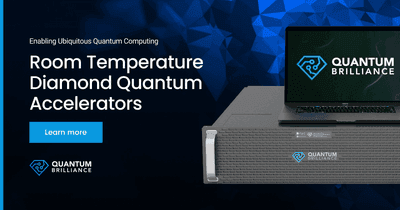
- Quantum Brilliance Quantum Brilliance develops quantum computing and sensing devices built on nitrogen-vacancy centres, which are atomic-scale defects in diamond whose electron and nuclear spins serve as qubits. Unlike many quantum machines, its diamond devices are designed to operate at room temperature without large cryogenic cooling systems, and to sit alongside conventional computing equipment. The company says its work builds on over 25 years of diamond quantum research at the University of Stuttgart and the Australian National University. It lists offices in Sydney, Stuttgart, Freiburg and Tokyo. This is quantum hardware, outside the usual scope of this directory. Quantum Computing —
- Quantum Source Weizmann Institute spin-off developing photonic quantum computers with millions of qubits using single atoms on photonic chips. Quantum Computing · Photonic Computing $77M ($50M Series A)

- Miraex Miraex builds thin-film lithium tantalate photonic integrated circuits, which are chips that guide light. The company aims to use them in transducers that convert signals between microwave and optical frequencies, so that superconducting quantum processors, sensors and networks could one day be linked over optical fibre. Its website places it at EPFL Innovation Park, with a footer address in Ecublens, Switzerland, near Lausanne. A news item on the site dated 2 June 2026 reports that SEALSQ acquired 100 percent of Miraex, so it is now a SEALSQ company. Quantum Computing · Photonic Computing —

- Qilimanjaro Quantum Tech Barcelona company building superconducting quantum systems, including an analog quantum computer at the Barcelona Supercomputing Center co-funded by EuroHPC. It announced a first close of nearly 19.6 million euros of a Series A led by Indra Group on 14 October 2026. Quantum Computing · Superconducting Computing EUR 19.6M Series A first close, Oct 2026

- Oxford Quantum Circuits Oxford Quantum Circuits builds superconducting quantum computers, which use electrical circuits cooled to extremely low temperatures as qubits. Its machines are offered through a cloud service sold as quantum computing as a service, placed in enterprise and sovereign data centres, or reached through APIs. The company markets them as application optimised compute and names finance, national security, pharmaceuticals and advanced materials as target areas. Its website lists Equinix, Digital Realty and NVIDIA among its partners. Quantum Computing $100M Series B in progress (SBI Investment, Chevron Technology Ventures, OSE)

- Qnami Qnami makes scanning NV quantum microscopes and the diamond probes they use. An NV centre is a tiny defect in diamond whose spin reacts to magnetic fields, so a sharp diamond tip can map magnetism on a very small scale, which helps in studying magnetic and superconducting materials. Its products include the ProteusQ and ProteusQ-LT microscopes and the Quantilever probes. This is a quantum sensing company, not a maker of computers. Its website carries the heading A Quantum Design Company and reports that it joined Quantum Design in June 2026. Its listed address is in Muttenz, near Basel, Switzerland. Quantum Computing CHF 6.6M

- Quantum Computing Inc Quantum Computing Inc. develops room-temperature photonic systems that use light to capture data, process complex problems and communicate securely, and it markets its Dirac line of optimization machines. It operates a foundry in Tempe, Arizona that fabricates thin-film lithium niobate chips, including electro-optic modulators and photonic integrated circuits on 150 mm wafers. The foundry held its grand opening on May 12, 2025. QCi positions the site as a first phase toward supplying data communications and telecom customers. Quantum Computing · Photonic Computing —

- imec Imec is a large independent research and innovation centre for nanoelectronics and digital technology, not a startup. It is headquartered in Leuven, Belgium, works with industrial partners, startups and more than 200 universities, and runs a 300 mm semiconductor pilot line. This entry covers its research into superconducting electronics and quantum devices, which aims to use standard chip manufacturing methods to build circuits that carry current with no resistance at very low temperatures. Its website describes a staff of about 6,500. Superconducting Computing · Quantum Computing —
- Nu Quantum Nu Quantum develops quantum networking hardware, meaning the links that connect separate quantum processors so they can work as one larger machine. Its products include Quantum Networking Units and Qubit-Photon Interfaces, which convert the state of a qubit into light that can travel between processors. It also offers Entanglement Fabric, a software layer that hides the details of those links from programmers. The company says it has worked on quantum networking since 2018. It is headquartered in Cambridge, United Kingdom, with a business office in Los Angeles. Quantum Computing · Photonic Computing $60M Series A (December 2025)
- Low Noise Factory Low Noise Factory develops cryogenic microwave components, with a focus on low-noise amplifiers built on InP HEMT transistors, a high-speed semiconductor device type that works at very low temperatures. Such amplifiers strengthen faint microwave signals while adding little noise of their own, which is why they are used to read out superconducting qubits. The company is a component supplier to quantum computing and other research users, not a computer maker. Its website states it has been amplifying the future since 2005. Quantum Computing —

- Anyon Systems Anyon Systems builds integrated superconducting quantum computers, which use electrical circuits cooled to near absolute zero as qubits. Its lineup includes Qube, a 24-qubit system, and Hudson, a next-generation enclosure for its machines. It also publishes Snowflurry, open-source software for pulse-level control, circuit compilation and algorithm libraries, which lets users steer the hardware at the level of individual control signals. The company lists its head office in Saint-Laurent, in the Montreal area of Quebec, Canada. Quantum Computing CAD $23M Canadian Quantum Champions (Dec 2025)

- Infleqtion Infleqtion builds quantum computers and quantum sensors, including atomic clocks and inertial sensors, using neutral atoms. Neutral atoms are uncharged atoms held in place and controlled with lasers, and each atom serves as a qubit, the basic unit of quantum information. This differs from superconducting designs, which use fabricated circuits cooled to near absolute zero. The company was founded in 2007 as ColdQuanta, adopted the Infleqtion name in 2022, is based in Louisville, Colorado, and has traded on the New York Stock Exchange as INFQ since February 2026. Quantum Computing >$550M via SPAC IPO (Feb 2026); $100M CHIPS LOI

- IBM Quantum IBM Quantum is the quantum computing business of IBM, not a separate company. It builds superconducting quantum processors, whose qubits are tiny circuits cooled in dilution refrigerators to near absolute zero, and offers them to users over the cloud. Cloud access began in May 2016 as the IBM Quantum Experience, now the IBM Quantum Platform. Its processor families include Eagle, Osprey, Heron and Condor, and its quantum systems are run from IBM data centres in New York State and elsewhere. Quantum Computing —

- kiutra kiutra makes cryostats, which are refrigerators that cool samples and quantum devices to temperatures near absolute zero. Instead of the rare isotope helium-3 used in dilution refrigerators, its systems cool magnetically, by magnetising and then demagnetising a solid material. Its range includes the L-Type Rapid, the X-Type and the T-Type Optical, and it offers measurement services from a characterisation lab. The company is a spin-off of the Technical University of Munich and is headquartered in Munich, Germany. Quantum Computing EUR 13M, Oct 2025

- Rigetti Computing Rigetti Computing designs and builds superconducting quantum processors, in which qubits are fabricated as circuits on silicon chips and operated at cryogenic temperatures. It makes its chips in its own fabrication facility and sells cloud access to its systems, along with smaller on-premises machines such as the 9-qubit Novera. Its cloud systems include the 84-qubit single-chip Ankaa-3 and the 36-qubit Cepheus-1-36Q, which is built from four 9-qubit chips. Rigetti was founded in 2013, is based in Berkeley, California, and trades on Nasdaq under the ticker RGTI. Quantum Computing —

- QuamCore Israeli developer of a superconducting quantum architecture that places digital control logic inside the cryostat, designed for one million qubits. It raised a $26 million Series A led by Sentinel Global in August 2025, bringing total funding to $35 million; the architecture is simulated and not yet built in hardware. Quantum Computing · Superconducting Computing $26M Series A, Aug 2025

- Oxford Ionics Oxford Ionics developed trapped-ion quantum computers, in which charged atoms held in electromagnetic traps act as qubits, the basic units of quantum information. The company says its qubit control chips can be made in standard semiconductor factories and that its processor is a swappable module about the size of a credit card. Its website carries IonQ's announcement that IonQ has completed its acquisition of Oxford Ionics, so it is now part of IonQ rather than an independent company. Quantum Computing £30M+ Series A
- IonQ IonQ builds trapped-ion quantum computers, in which individual charged atoms held in electromagnetic traps act as qubits and are manipulated with lasers. The company sells access to its systems through major cloud platforms and its own service, and also develops software for running quantum circuits. It was founded in 2015 by Christopher Monroe and Jungsang Kim, drawing on their academic ion-trap research. IonQ is headquartered in College Park, Maryland, and has been listed on the New York Stock Exchange under the ticker IONQ since 2021. Quantum Computing $1B+ acquisitions
- SCALINQ SCALINQ supplies hardware for building quantum computers rather than classical compute. Its products include LINQER, a packaging solution for superconducting and spin-qubit processors, CliQ filters, BriQ connector blocks and VIDAR, a travelling-wave parametric amplifier, which boosts very weak qubit signals with little added noise. VIDAR was launched with QET Sweden, a Chalmers University of Technology spin-out, at the APS March Meeting 2025. The company's website lists an address in Gothenburg, Sweden, and names Chalmers, Qblox and Atlantic Quantum as partners. Quantum Computing —

- Microsoft Quantum Microsoft Quantum is the quantum computing effort of Microsoft, not a separate company. It has two parts. Azure Quantum is a cloud service that gives developers access to quantum hardware from partners including Quantinuum, IonQ and Atom Computing, and Microsoft created the Q# language for it. Separately, Microsoft is building its own hardware. It announced the Majorana 1 chip in February 2025 as a step toward topological qubits, a design intended to resist errors at the hardware level. Many physicists question whether the published data show true topological states or a working qubit. Microsoft is headquartered in Redmond, Washington. Quantum Computing —

- IQM Quantum Computers IQM builds superconducting quantum computers, which use small electrical circuits cooled to near absolute zero as qubits, the basic units of quantum information. It offers systems of 5, 20, 54 and 150 qubits for universities, supercomputing centres and companies, run on site or through a cloud platform. Customers and partners named on its website include the German Aerospace Center DLR and Telefónica, which is providing a system to the Community of Madrid. The company is based in Espoo, Finland, and was founded in 2018. Quantum Computing €275M Series B (Sep 2025, Ten Eleven/Tesi-led); €50M BlackRock (Mar 2026)

- Quantinuum Quantinuum builds trapped-ion quantum computers, including the H-series and the newer Helios system, in which atomic ions serve as qubits. It also develops quantum software and offers cloud access to its hardware. The company was formed in 2021 by combining Honeywell Quantum Solutions, the hardware unit, with Cambridge Quantum, the software firm, and Honeywell was the majority shareholder at formation. Quantinuum has operations in Broomfield, Colorado and Cambridge, United Kingdom. Quantum Computing $600M (2025, $10B valuation, NVIDIA participated)

- Duality Quantum Photonics Bristol company building photonic processors and photonic chips for quantum and classical computing, with chip design in Bristol and fabrication at a Southampton facility according to its LinkedIn page. Its site lists projects including real-time fusion diagnostics and connecting photonic processors to quantum systems. It has been low-profile, and no funding round has been announced. Quantum Computing · Photonic Computing —
- C12 Quantum Electronics C12 Quantum Electronics builds quantum computing hardware from carbon, using carbon nanotubes, which host spin qubits, rather than the superconducting circuits used by many rivals. Carbon nanotubes are hollow tubes of carbon about a nanometre wide. The company has described a nanoassembly process called Pick and Place for manufacturing nanotube quantum chips at larger scale. It has set out a roadmap toward fault-tolerant quantum computing, meaning machines that correct their own errors, which it has not yet demonstrated. Its address is in Paris, France, and it lists Thales as a collaborator on a radar tracking project. Quantum Computing €18M (~$19.4M) pre-Series A (2025)

- Diraq Diraq builds quantum computers based on spin qubits made from modified silicon transistors. A spin qubit stores quantum information in the spin of a single electron, and using transistor-like devices means the chips can in principle be made in existing semiconductor factories. The company was founded in 2022 as a spin-out from UNSW Sydney and is led by Andrew Dzurak. It lists GlobalFoundries and imec as manufacturing partners and has published results in Nature journals on silicon qubit fidelity. Quantum Computing $38M CHIPS Act LOI (May 2026); AU$20M NRFC equity (Feb 2026)

- Snowcap Compute Snowcap Compute is developing a superconducting computing platform that lets partners move existing digital chip designs, such as processors, graphics chips or AI inference accelerators, onto superconducting technology running at 4.5 kelvin, about minus 269 degrees Celsius. Superconducting circuits carry current without electrical resistance. It is classical digital computing, not a quantum computer. The company says Mike Lafferty is chief executive, Pat Gelsinger sits on its board, and Playground Global led a $23 million seed round. AI Accelerators · Quantum Computing $23M seed (Jun 2025, led by Playground Global)

- QBoson QBoson, also known as Boseq, is a Beijing-based company building photonic machines for combinatorial optimisation and probabilistic sampling. Its machines are coherent Ising machines, which use pulses of light to search for low-energy solutions to optimisation problems. They are special-purpose devices and cannot run general-purpose quantum algorithms, and whether they offer any advantage over classical methods is still debated. It also offers the Kaiwu software development kit and a cloud platform. It has laboratories in several Chinese cities and a factory in Shenzhen. A founding year could not be confirmed. This is quantum-inspired or photonic hardware, outside the usual scope of this directory. Quantum Computing · Photonic Computing —

- Q-CTRL Q-CTRL is a software company that makes tools to improve the performance of quantum hardware. Fire Opal reduces errors on cloud-accessible quantum computers, Boulder Opal helps design and tune qubit controls, and Ironstone Opal is used for navigation without GPS using quantum sensors. It also offers the Black Opal education product. It does not build quantum computers. Its founder and chief executive is Michael Biercuk, and its record places it in Sydney, Australia. Quantum Computing —

- KETS Quantum Security KETS Quantum Security makes chip-based quantum security products. Its range covers quantum key distribution (QKD), which uses the physics of single photons to share encryption keys so that eavesdropping can be detected, and quantum random number generators (QRNG), which draw randomness from quantum effects instead of software. It also lists a product called KETS Kore. The company builds both full systems and sub-systems and says they are designed to scale. Its published address is in Bristol, United Kingdom, and Chris Erven is named as chief executive. Quantum Computing £1.7M Innovate UK SBRI contract (2025)

- Universal Quantum Universal Quantum is a UK company building trapped-ion quantum computers, in which charged atoms held in electromagnetic traps act as qubits, the basic units of quantum information. It describes its design as modular, meaning a larger machine is assembled from smaller connected units rather than built as one block. The company says its aim is utility-scale machines, meaning ones large enough to solve useful problems. Its headquarters, founding year and contracts could not be confirmed from the sources reachable for this review. Quantum Computing €67M+ DLR contract

- TuringQ TuringQ develops photonic chips and quantum computing products, using thin-film lithium niobate, an electro-optic material that guides light and lets electric signals modulate it. In photonic quantum computing, information is carried by single photons rather than superconducting circuits. Its listed offerings include a photonic quantum computing development platform, a quantum programming framework called DeepQuantum and a quantum encryption chip. The company lists its headquarters in Minhang District, Shanghai, and its website links to a photonic quantum laboratory at Shanghai Jiao Tong University. It is a quantum computing record, which sits at the edge of the site's scope. Quantum Computing · Photonic Computing —
- Quantum Dice Oxford University spinout founded in 2020 that makes photonic quantum random number generators with an on-chip laser source and continuous self-certification of the randomness produced. It has developed a compact enterprise QRNG with an Innovate UK grant, supplied a first space product for a SpeQtral satellite mission, and is working on a miniaturised IoT version. Quantum Computing · Photonic Computing 2M USD pre-seed plus 2.09M USD Innovate UK grant (dates not confirmed)

- QuantumCTek Hefei company listed on Shanghai's STAR Market that makes quantum key distribution, quantum computing control and measurement products. A China Telecom unit agreed in March 2024 to pay 1.9 billion yuan for a 23.1 percent stake, and the firm co-developed the 504-qubit Tianyan-504 with China Telecom Quantum Group and the Chinese Academy of Sciences in December 2024. Quantum Computing —

- Covesion Southampton maker of periodically poled lithium niobate (PPLN) crystals, waveguides and modulators for photon-pair generation, quantum frequency conversion and laser systems; a University of Southampton spin-out incorporated on 9 August 2007 and now Hawthorn Photonics (UK) Ltd. AdvR Inc. of Bozeman, Montana joined it under the Hawthorn Photonics group in an announcement of 5 June 2025, and AdvR products are now sold under the Covesion brand. Covesion added a second site at Southampton Science Park in November 2025, announced a 616 to 637 nm tunable laser on 9 January 2026, lists ORCA Computing among its partner logos, and exhibits at the UK National Quantum Technologies Showcase on 6 November 2026. Quantum Computing · Photonic Computing —

- Aegiq Aegiq develops photonic quantum computers that it aims to scale toward fault tolerance, meaning machines that keep computing correctly despite errors. It combines deterministic photon sources, which emit single photons on demand, with silicon photonics, which routes light on chips made with standard semiconductor processes. The company says this approach should reduce the complexity, cost and size needed to scale. Its products also include quantum light sources and the LightWorks software development kit. It follows a fabless model, meaning it designs its chips and has outside semiconductor foundries manufacture them. Quantum Computing · Photonic Computing £23M+

- SEEQC SEEQC builds a digital-chip platform for quantum computing that pairs superconducting qubit chips with classical control chips based on single flux quantum logic, packaged together inside the cryostat. Conventional machines keep control electronics at room temperature and connect them with many cables. SEEQC's control logic sits in the cold stages close to the qubits, which the company says supports fast on-chip readout and feedback. It also offers chip foundry and fabrication services, and its site gives 2019 as its founding year. Quantum Computing · Superconducting Computing $30M Series A extension (Jan 2025)

- Bleximo Application-specific superconducting quantum computers (qASIC) co-designed with algorithms for materials simulation. Quantum Computing $2.6M

- Qunnect Qunnect builds quantum networking equipment. Its main product, Carina, is a turnkey system that creates, distributes and checks entanglement, a quantum correlation between particles that networks use to link distant quantum devices. It is designed to install like ordinary telecom equipment and to run over existing fibre that also carries normal data traffic. The company also makes Qu-MEM, which it describes as a commercial quantum memory for storing quantum states of light. Its website lists networks named ABQ-NET, BearlinQ, GothamQ and QCORE. The company is based in Brooklyn, New York, according to this directory. Quantum Computing $10M Series A extension (Jun 2025, led by Airbus Ventures, Cisco)

- Multiverse Computing Multiverse Computing is a software company with two product lines. CompactifAI compresses large AI models, using methods borrowed from quantum physics, so they run on smaller and cheaper hardware. Singularity is software for applying quantum and quantum-inspired methods to problems in finance and industry. It builds no processors of its own. The company was founded in 2019 by Enrique Lizaso, Roman Orus, Alfonso Rubio-Manzanares and Sam Mugel, and is headquartered in San Sebastian, Spain. Quantum Computing $215M Series B (June 2025, Bullhound-led); seeking €500M at €1.5B valuation

- ORCA Computing ORCA Computing builds photonic quantum computers, which use particles of light as qubits and need less extreme cooling than superconducting designs. Its PT Series systems are designed to plug into existing data centre infrastructure. The company says it has deployed 11 systems in data centres worldwide and works with more than 35 enterprise and public sector partners. Its website lists NVIDIA, Digital Realty, Vodafone and the UK National Quantum Computing Centre among those it works with. The company is headquartered in London, United Kingdom. Quantum Computing · Photonic Computing $37M Series B (Nov 2025, NVentures/Temasek/Baillie Gifford/QIA)

- Origin Quantum Origin Quantum is a Chinese company working on superconducting quantum computers, a different technology from the classical compute hardware that this directory mainly covers. Its listing here reflects a Wukong machine and control software, but its headquarters in Hefei and founding year of 2017 could not be confirmed from sources checked for this update. Readers should treat it as a quantum computing record that sits at the edge of the site's scope. Quantum Computing —

- SQSilicon Quantum Computing Silicon Quantum Computing builds quantum processors from silicon and phosphorus atoms, placing the atoms in the chip with atomic precision. Qubits are the basic units of quantum computing, and here they are encoded in the spins of individual phosphorus atoms embedded in silicon. Its site lists Watermelon, a quantum feature generator for machine learning workflows, and Quantum Twins, a quantum analogue simulator for chemicals and materials. Gate-based processors called the Chilli Series are listed as coming soon. The company was founded in 2017 in Sydney, Australia, by Michelle Simmons, who is also chief executive. Quantum Computing A$20M from National Reconstruction Fund (2026, SAFE note)
- PsiQuantum PsiQuantum is developing a photonic quantum computer that encodes qubits in single photons and manipulates them with silicon photonic chips. It works with GlobalFoundries to manufacture those chips in a commercial semiconductor foundry, and it has announced Omega, a chipset built for this purpose. The company is building large fault-tolerant systems rather than selling small machines today, with planned compute centers in Brisbane and Chicago. PsiQuantum was founded in 2016, grew out of research at the University of Bristol, and is a private company based in Palo Alto, California. Quantum Computing · Photonic Computing $1B Series E (Sep 2025; BlackRock, Temasek, Baillie Gifford, NVentures)

- Coherence Engine Cambridge Future Tech portfolio company building electronic design automation software for quantum computers, covering simulation, validation and optimisation across the analogue, digital and software layers of a quantum architecture. It describes its aim as scaling to million-qubit systems. Directory sources date its founding to August 2024 and pre-seed funding to January 2025. Quantum Computing Pre-seed (Jan 2025, amount unconfirmed)

- EeroQ EeroQ is developing a quantum computer in which single electrons are trapped above a film of superfluid helium inside tiny channels etched into silicon chips. At present each qubit is encoded in the electron's sideways motion, with the longer-term aim of using the electron's spin, a magnetic property. Logic gates are driven by microwave signals. The company says the control electronics can be made with standard CMOS chip manufacturing, the same process used for conventional processors. Quantum Computing Strategic investment from SEALSQ (Dec 2025 and Feb 2026)
- eleQtron eleQtron builds trapped-ion quantum computers, in which charged atoms held in electromagnetic traps act as qubits. Its MAGIC concept, short for Magnetic Gradient Induced Coupling, controls the ions with microwaves instead of lasers, which the company says is more precise and scales better. The company was founded on 12 May 2020 and is based in Siegen, Germany. It lists the German Aerospace Center DLR as a 2023 customer and Forschungszentrum Jülich as a 2024 customer, with a system integrated into the Jülich supercomputing centre. Quantum Computing €57M Series A (May 2026, Schwarz Digits-led)

- planqc planqc builds neutral-atom quantum computers, which use individual uncharged atoms held in place by focused laser beams as qubits. Its systems can be run on premises, through the cloud or integrated with high-performance computing centres. The company also develops MAQCS, a multicore atomic quantum computing system. planqc was founded in 2022 by the quantum physicists Glaetzle, Blatt and Zeiher as a spin-off from the Max Planck Institute of Quantum Optics. It is based in Garching near Munich, Germany, and is the first startup of Munich Quantum Valley. Quantum Computing €50M Series A (2024, CATRON/DTCF); €21M LRZ + €29M DLR government contracts

- SpinQ SpinQ is a Chinese quantum computing company operating as Shenzhen SpinQ Technology. It sells two kinds of hardware. Its industrial systems use superconducting qubits, while its educational desktop and portable machines use nuclear magnetic resonance, which reads the spins of atomic nuclei in a liquid sample at room temperature. It also provides a cloud platform with graphical circuit design and QASM programming, plus quantum control and measurement systems and chip design software. Quantum Computing ~1B RMB ($145M) Series C (Q1 2026)

- QMill QMill is a quantum algorithm and software company, not a hardware maker. It offers quantum-safe security and optimisation tools, and it mixes AI with quantum and classical computing to support organisational decisions. Optimisation here means finding the best option among very many possibilities, such as scheduling or routing. Its website lists a head office in Espoo, Finland. The company says its chief scientist, Mikko Möttönen, co-founded IQM in 2018 and then QMill, which this directory dates to 2024. Quantum Computing €4M ($4.5M) Seed (Sept 2024, Maki.vc and Antler-led)

- ZuriQ ZuriQ is developing a trapped-ion quantum computer, in which each qubit is encoded in the internal energy states of an individual charged atom held in place by electromagnetic fields. The company describes a three-dimensional architecture that it hopes will let it add qubits while keeping connectivity and accuracy high, and it is working toward silicon chip fabrication. Its website names Infineon among its partners. No large-scale machine has been shown yet. This is quantum hardware, so it sits outside the conventional compute categories this directory mainly covers. Quantum Computing $4.2M seed (Jan 2025)

- Pasqal Pasqal builds neutral-atom quantum processors, in which atoms held by focused laser beams act as qubits, and offers them both as on-premise hardware and through cloud access. It also sells software development kits and professional services to help customers port workloads. Its website names Thales, Sumitomo, BMW Group and Capgemini among its customers and partners, and lists IBM, NVIDIA, Microsoft and Google as technology partners. It reports more than 25 commercial use cases. Quantum Computing ~€340M (March 2026) ahead of $2B SPAC listing

- QpiAI Bengaluru company that launched the 25-qubit superconducting QpiAI-Indus in April 2025, described as India's first full-stack quantum computer under the National Quantum Mission. It raised a $32 million Series A co-led by the mission and Avataar Ventures and plans 128 qubits within two years. Quantum Computing $32M Series A

- Riverlane Riverlane develops quantum error correction technology. Qubits are fragile and make frequent mistakes, so a quantum computer needs fast classical hardware and software to detect and fix errors while a calculation runs. Riverlane's Deltaflow products include a real-time decoder, which turns the error signals read from the qubits into corrections. The company is based in Cambridge, UK, and sells its technology to quantum hardware builders rather than making its own quantum computer. Quantum Computing $75M Series C (2025, led by Planet First Partners)

- Qblox Qblox makes control electronics for quantum computers. Each qubit must be driven and read out with precisely timed electrical pulses, and Qblox supplies this in modular units that combine into its Cluster control stack, alongside its Scheduler software. Its modules serve superconducting and spin qubits. The company works with TNO, TU Delft and QuTech, the Delft quantum research institute. Its co-founders are Niels Bultink, the chief executive, and Jules van Oven, the chief innovation officer. Quantum Computing ~$26M Series A, Jun 2024

- Algorithmiq Algorithmiq develops quantum algorithms, which are the software instructions that run on quantum computers, with a focus on healthcare and life sciences. Its work covers quantum chemistry problems and drug discovery methods that combine quantum computers with AI. It also offers a Digital Quantum Interface that connects classical computers to quantum machines. The company does not make quantum hardware. Its website now lists its headquarters at an address in Milan, Italy, although the company has previously been associated with Helsinki, Finland. Quantum Computing €18M (May 2026, United Ventures/CDP-led; total €36M)

- ConScience AB ConScience AB is a Swedish cleanroom fabrication company that makes micro and nanostructures for research and development teams, covering quantum devices, microfluidics, nanoplasmonic sensors and semiconductor devices. Its quantum products include the QiB0, QiB1 and QiB2 superconducting qubit chips and a Plug'N'Teach teaching kit for universities. It is a fabrication and devices supplier, not a computer maker. Its website gives Göteborg as its address and lists a Danish subsidiary, ConScience ApS. Quantum Computing —

- SemiQon SemiQon is a Finnish company building silicon-based quantum hardware. Its SemiQit product is a set of silicon quantum dot devices for research, where a quantum dot traps a single electron and the electron's spin can serve as a qubit, the basic unit of quantum computing. It also offers cryo-optimised CMOS circuits, which are ordinary chip technology adapted to work at very low temperatures to help scale up quantum machines. Quantum processor chips are listed on its site as coming soon. A news item on its site calls it Espoo-based, and this directory describes it as a spinout from VTT. Quantum Computing €17.5M (2025, equity + EIC grant)

- AQSolotl AQSolotl is recorded as a Singapore company making a quantum controller, the electronics that sit between a conventional computer and a quantum processor to send control pulses and read out qubit states. Its website was reachable but showed only navigation links, so its CHRONOS-Q product, the speed claim, the 2024 founding year and its location could not be verified. This entry is provisional, and it is quantum control hardware rather than classical compute. Quantum Computing —

- Atom Computing Atom Computing builds quantum computers that use neutral atoms as qubits. Individual atoms of elements such as ytterbium are held in place by focused laser beams in a grid, and information is stored in their nuclear spin. Its system for on-premises deployment is called the AC1000. The company was founded in 2018 by Ben Bloom and Jonathan King and is based in Berkeley, California. In November 2024 it worked with Microsoft to entangle 24 logical qubits, each encoded across several physical atoms to reduce errors. These were early demonstrations, not full fault tolerance. Quantum Computing —

- QuantWare QuantWare designs and sells quantum processors (QPUs) built on its VIO technology, in the A-Line and D-Line families. Rather than building a full computer, it supplies chips, peripheral components, and foundry and packaging services so that other firms can assemble their own systems. Organisations named on its site as customers include Alice & Bob, Riverlane, SEEQC, Quantum Machines and Qblox. QuantWare is based in Delft, Netherlands, and says it serves customers in 20 countries. Quantum Computing $178M Series B (May 2026)

- Conductor Quantum Conductor Quantum makes software for quantum computers rather than hardware. Its Coda product lets a user describe a task in plain language, then generates quantum programs, runs them and returns the results. Its Control product automates calibration, the repeated tuning needed to bring qubits into working order and keep them there, and supports superconducting, spin, trapped-ion and photonic machines. Coda connects to cloud quantum computers from IonQ, IQM, Rigetti, AQT and IBM. The company's website does not state its headquarters or founding year. Quantum Computing $0.5M pre-seed

- Quandela Quandela is a French company building photonic quantum computers, which use single particles of light, called photons, as qubits, the basic units of quantum information. Photonic designs differ from superconducting or trapped-ion machines because the qubits are light travelling through optical circuits rather than trapped atoms or superconducting circuits. Quandela sells quantum computers and offers cloud access to its processors. Its founding year, headquarters and specific system deliveries could not be confirmed from the sources reachable for this review, so none are stated. Quantum Computing · Photonic Computing €50M+ Series B

- Quantum Art Israeli developer of full-stack trapped-ion quantum computers using a multi-core architecture. It closed a $100 million Series A led by Bedford Ridge Capital on 10 December 2025, later extended to $140 million, to build Perspective, a planned 1,000-qubit system, and says it has demonstrated a 200-ion chain. Quantum Computing $140M Series A, Dec 2025

- Oxford Instruments This record covers Oxford Instruments plc, a British maker of tools and systems for industry and research, not a quantum computing company as such. Its products image, analyse and manipulate materials. Sir Martin Wood founded it in 1959 to make superconducting magnets, and it is listed on the London Stock Exchange. Its quantum cryogenics unit, NanoScience, was agreed for sale in June 2025 for 60 million pounds, according to the company's Wikipedia entry. Quantum Computing —

- ParTec ParTec is a German supercomputing company that develops ParaStation Modulo, software for running and managing clusters, and promotes the Modular System Architecture, in which separate pools of general purpose, GPU and other nodes share one network so a job can use each type as needed. This differs from clusters where every node is identical. It worked with Eviden on JUPITER, which was inaugurated at Forschungszentrum Julich on 5 September 2025. ParTec is headquartered in Munich. HPC & AI Systems · Quantum Computing —

- Classiq Classiq sells a software platform for designing quantum algorithms. Users describe what a program should do in its Qmod language or in plain text, and the platform synthesises an optimised quantum circuit that can run on quantum hardware from different makers or on simulators. It does not build quantum computers itself. The company says it is SOC 2 and GDPR compliant and lists offices in the United States, Japan, Germany, South Korea, France, the Netherlands, India, Italy, Singapore and Israel. Quantum Computing $110M Series C (May 2025), extended to $200M+

- Akhetonics Akhetonics is developing an all-optical processor, which it calls the Reasoning Processing Unit, that handles data as light throughout instead of converting it to electrical signals. It aims the chip at reasoning, verification and optimisation workloads. The company says it uses optical nonlinearities generated in photonic integrated circuits, and it describes a platform that covers digital, analog and quantum optical computing. Michael Kissner is co-founder and chief executive, and Leonardo Del Bino is co-founder and chief technology officer. Quantum Computing · Photonic Computing €6M seed (Nov 2024, Matterwave Ventures)

- Quobly Grenoble spin-out of CEA-Leti and CNRS building silicon spin-qubit processors on 300 mm FD-SOI CMOS lines at STMicroelectronics in Crolles. It received 21 million euros in May 2025 for a 100-qubit chip and closed a 115 million euro Series A led by Bpifrance, SEALSQ and STMicroelectronics in June 2026, with cloud access to its Alloy Pioneer system planned for end 2026. Quantum Computing EUR 115M Series A, Jun 2026

- ICEoxford Witney, Oxfordshire maker of cryostats and dilution systems, incorporated on 7 September 2004. Products include the DRY ICE and WET ICE series, the DRY ICE-Q DYAD low-vibration cryostat and, announced in November 2025, the ICE-Q modular platform of rack-mounted cube modules with a patent-pending side-loading wiring module. ICE-Q is being developed with Photonic Inc (Canada) in a joint UK-Canada funded project and with Rutherford Appleton Laboratory for a dark matter module, with roadmap options at 10 mK and 4 K; it was shown at the UK National Quantum Technologies Showcase and slated for the APS meeting in March 2026. Quantum Computing —

- Ephos Ephos is an Italian company developing photonic chips for quantum computing, made on glass rather than silicon. In photonic quantum computing, information is carried by particles of light guided through tiny channels on a chip, called waveguides, and glass can carry light with low loss. The company is listed as based in Milan. Its founding year, funding and any manufacturing plans could not be confirmed from the sources reachable for this review, so none are stated here. Quantum Computing · Photonic Computing €41.5M EU Chips Act grant (July 2025) for Fab-2

- SQSparrow Quantum Copenhagen spin-out from the Niels Bohr Institute making Sparrow Core, an on-chip deterministic single-photon source from InAs/GaAs quantum dots for photonic quantum computing. It raised a 21.5 million euro Series A led by PensionDanmark in April 2025, later reported as 27.5 million euros. Quantum Computing · Photonic Computing EUR 27.5M Series A, 2025
- Google Quantum AI Google Quantum AI is the quantum computing research division of Google, not a separate company. It designs superconducting quantum processors and works on quantum error correction, which spreads information across many physical qubits to catch mistakes. Its Sycamore chip underpinned a 2019 claim of quantum supremacy, and its Willow chip, announced in 2024, showed error rates falling as the error-correcting code grew. The lab was launched in 2013 and has its hardware facility in Goleta, near Santa Barbara, California. Quantum Computing —

- Maybell Quantum Colorado maker of dilution refrigerators and cryogenic RF systems for quantum computers, including the Big Fridge developed with Colorado School of Mines. It raised a $25 million Series A in March 2024 and a $40 million Series B led by Addition in September 2025, and is to deploy four refrigerators at the Roadrunner Quantum Lab in Albuquerque by September 2026. Quantum Computing · Superconducting Computing $40M Series B, Sep 2025